
座標平面上的旋轉變換

座標平面上的旋轉變換
臺北市立西松高中 蘇惠玉教師
二階方陣所對應的旋轉變換
將平面上的點 \(P(x,y)\),以坐標軸原點 \(O\) 為旋轉中心,逆時針旋轉 \(\theta\) 角(當 \(\theta<0\) 時可考慮為順時針旋轉),得到點 \(P\) 經旋轉之後的像為 \(P’=(x’,y’)\),這樣的變換稱為旋轉變換。
我們先以極坐標來表示 \(P\) 點坐標:
在坐標平面上,若 \(P\) 點到原點 \(O\) 的距離為 \(r\),以 \(x\) 軸正向為始邊,
逆時針旋轉到 \(\overrightarrow{OP}\) 的角度為 \(\alpha\),那麼點 \(P(x,y)\) 的極坐標為 \(P[r,\alpha]\),
且 \(x=r\cos \alpha,y=r\sin \alpha\),
並可得點 \(P\) 經逆時針旋轉 \(\theta\) 角的像 \(P’=(x’,y’)\) 的極坐標為 \(P'[r,\alpha+\theta]\),
其中 \(x’=r\cos {(\alpha+\theta)},y=r\sin {(\alpha+\theta)}\)。
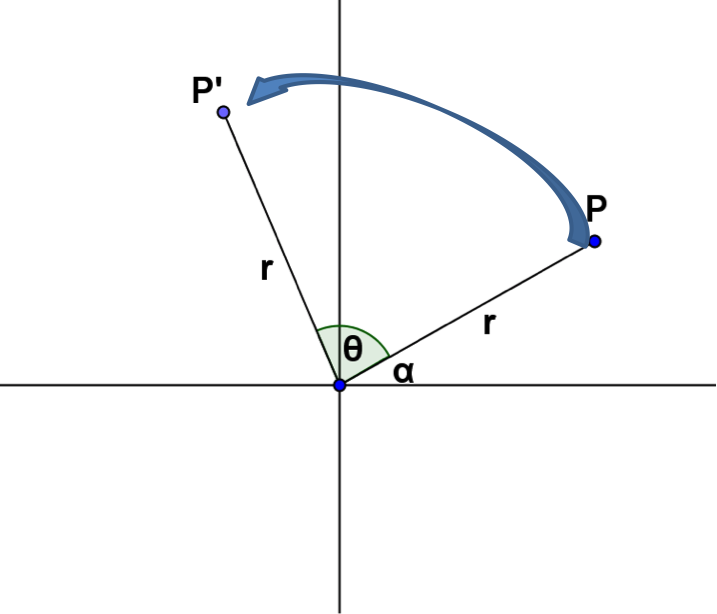
若我們將點坐標以行矩陣來表示,即
\(\left[ \begin{array}{l} {x’}\\ {y’} \end{array} \right] = \left[ \begin{array}{l} r\cos (\alpha + \theta )\\ r\sin (\alpha + \theta ) \end{array} \right]=\left[ \begin{array}{l} r\cos \alpha \cos \theta – r\sin \alpha \sin \theta \\ r\sin \alpha \cos \theta + r\cos \alpha \sin \theta \end{array} \right]=\left[ \begin{array}{l} \cos \theta \cdot x – \sin \theta \cdot y\\ \sin \theta \cdot x + \cos \theta \cdot y \end{array} \right]=\left[ \begin{array}{rr} \cos \theta& -\sin \theta \\ \sin \theta &\cos \theta \end{array} \right]\left[ \begin{array}{l} x\\ y \end{array} \right]\)
其中 \(\left[ \begin{array}{rr} \cos \theta& -\sin \theta \\ \sin \theta &\cos \theta \end{array} \right]\) 稱為此旋轉變換所對應的旋轉矩陣,記作 \(R(\theta)\)。
當我們利用二階方陣表示旋轉變換,
那麼接下來就可以用矩陣的運算來表徵這個變換的某些性質。
考慮兩個旋轉矩陣 \(R(\theta_1)\) 與 \(R(\theta_2)\) 相乘,
\(R({\theta _1})R({\theta _2}) = \left[ \begin{array}{rr} \cos {\theta _1} &- \sin {\theta _1}\\ \sin {\theta _1} &\cos {\theta _1} \end{array} \right]\left[ \begin{array}{rr} \cos {\theta _2}& – \sin {\theta _2}\\ \sin {\theta _2}&\cos {\theta _2} \end{array} \right] = \left[ \begin{array}{rr} \cos\theta_1\cos\theta_2-\sin\theta_1\sin\theta_2 & -\cos\theta_1\sin\theta_2- \sin\theta_1\cos\theta_2\\ \sin\theta_1\cos\theta_2+\cos\theta_1\sin\theta_2&-\sin\theta_1\sin\theta_2+\cos\theta_1\cos \theta_2\end{array}\right] =\left[ \begin{array}{rr} \cos{(\theta_1+\theta_2)} & -\sin{(\theta_1+\theta_2)}\\ \sin{(\theta_1+\theta_2)}&\cos{(\theta_1+\theta_2)} \end{array} \right]\)
也就是說,兩個旋轉矩陣相乘的結果,就是「角度」相加。以旋轉的角度來考慮,亦即 \(P\) 點先逆時針旋轉 \(\theta_2\),再旋轉 \(\theta_1\) 的角度,也就是 \(P\) 點共旋轉了 \(\theta_1+\theta_2\)的角度。
由此推廣,可得 \([R(\theta)]^n=R(n\theta)\)。同時,考慮 \(R(\theta)\) 的反方陣
\(R^{-1}(\theta) = \frac{1}{1} \cdot \left[ \begin{array}{rr} \cos\theta & \sin \theta \\ -\sin\theta & \cos\theta \end{array} \right] =\left[ \begin{array}{rr} \cos{(-\theta)} & -\sin{(-\theta)}\\ \sin{(-\theta)}&\cos{(-\theta)}\end{array}\right]= R( – \theta )\)
也就是說,當 \(P\) 點逆時針旋轉 \(\theta\) 角度之後,在順時針旋轉 \(\theta\) 角度即可回到原來的 \(P\) 點。換句話說,當逆時針旋轉 \(\theta\) 角度的旋轉矩陣為 \(R(\theta)\),那麼順時針旋轉 \(\theta\) 角度的旋轉矩陣即為 \(R(-\theta)\)。
複數相乘的幾何意義
對任一複數 \(z=x+yi\),\(x,y\in \Re\),我們可以將其考慮成數對 \((x,y)\) 並畫在複數平面上,以點 \(P(x,y)\) 來表示這個複數,那麼就可定義 \(|z|=\sqrt{x^2+y^2}\) 為點 \(P\) 到原點的距離,簡單說,也就是 \(z\) 這個複數的「長度」;若以實軸(橫軸)的正向為始邊,逆時針旋轉到 \(\overline{OP}\) 的角度為 \(\theta\),改以極坐標來表示為 \(P[r,\alpha]\),其中 \(x=r\cos\theta,y=r\sin\theta\)。
因此,可將複數 \(z\) 表示成極式 \(z=r(\cos\theta,i\sin\theta)\),其中 \(r=|z|=\sqrt{x^2+y^2}\),\(\theta\) 稱為 \(z\) 的幅角 (argument)。
當複數以極式來表示的時候,藉由此,我們就可從幾何的角度來探討複數乘除運算的幾何意義。
假設兩個複數 \(z_1,z_2\),\(z_1=r_1(\cos{\theta_1}+i\sin\theta_1),z_2=r_2(\cos{\theta_2}+i\sin\theta_2)\) ,
則它們的乘積可計算為
\(\begin{array}{ll}z_1\cdot z_2 &=r_1(\cos {\theta _1} + i\sin {\theta _1}) \cdot {r_2}(\cos {\theta _2} + i\sin {\theta _2}) \\&= {r_1}{r_2}[(\cos {\theta _1}\cos {\theta _2} – \sin {\theta _1}\sin {\theta _2}{\rm{) + }}i(\cos {\theta _1}\sin {\theta _2} + \sin {\theta _1}\cos {\theta _2})] \\&= {r_1}{r_2}[\cos ({\theta _1}{\rm{ + }}{\theta _{\rm{2}}}{\rm{) + }}i\sin ({\theta _1}{\rm{ + }}{\theta _{\rm{2}}}{\rm{)]}}\end{array}\)
這兩個複數的極式相乘告訴我們,當兩個複數相乘時,其「長度」相乘,「角度」相加。
換個角度說明,當 \(z_1\) 這個複數乘以另一個複數 \(z_2\),可以考慮成 \(z_1\) 所代表的點 \(P\),將它到原點的距離 \(r_1\),作伸縮變換變成 \(r_1r_2\);將它與橫軸正向所成的有向角 \(\theta_1\),繞原點逆時針旋轉了 \(\theta_2\) 的角度,如下圖所示:
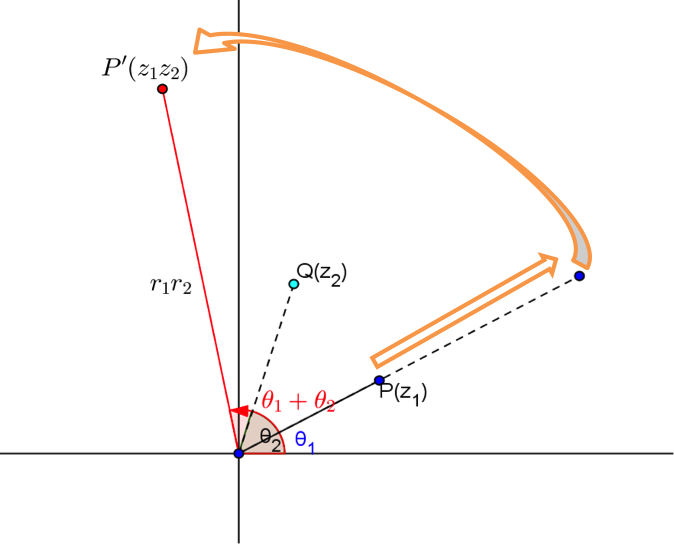
若單純只考慮一個複數 \(z\),將它乘以 \(\cos\theta+i\sin\theta\),幾何呈現上的意義即是將此複數以原點為旋轉中心,逆時針旋轉 \(\theta\) 角度(當 \(\theta<0\) 時為順時針旋轉)。但是這樣的旋轉與以二階方陣所表徵的旋轉變換是否相同呢?
設此複數 \(z=x+yi\),在複數平面上以點 \(P(x,y)\) 表示此複數,經繞原點逆時針旋轉 \(\theta\) 角度之後,所得到新的點為 \(P’=(x’,y’)\),由旋轉變換可知
\(\left[ \begin{array}{l} {x’}\\ {y’} \end{array} \right] = \left[ \begin{array}{rr} \cos \theta&-\sin\theta\\ \sin\theta & \cos \theta \end{array} \right]\left[ \begin{array}{l} x\\ y \end{array} \right] = \left[ \begin{array}{l} x\cos \theta – y\sin \theta \\ x\sin \theta + y\cos \theta \end{array} \right]\)
亦即 \(x’=x\cos \theta-y\sin \theta,y’=x\sin \theta+y\cos\theta\),因此
\(\begin{array}{ll} z’ &= (x\cos\theta-y\sin\theta)+i(x\sin\theta+y\cos\theta)\\ &=x(\cos\theta+i\sin\theta)+yi\cdot(\cos \theta+i\sin\theta)\\&= (x +yi)\cdot(\cos\theta+i\sin\theta)=z\cdot(\cos\theta+i\sin\theta)\end{array}\)
由此可知,當我們將平面上的點考慮成複數時,依複數極式乘法運算所處理的旋轉變換,與二階方陣所代表的旋轉變換是一致的。對平面上的旋轉變換而言,我們常依點所表徵的意義不同,而選擇不同的呈現方式來處理幾何上的旋轉變換,不過表面上不同,裡子卻是一樣的。而有時候通過複數的極式來作運算,反而可以讓運算變得更加的簡潔易懂。
 前一篇文章
前一篇文章 下一篇文章
下一篇文章


負數相乘處r1r2後是否應加上中括弧?