數學

樣本空間( Sample space)

樣本空間( Sample space)
國立屏東高級中學數學科楊瓊茹老師

日常生活中常使用到「可能」這個字眼,面對種種事先無法預知結果的隨機現象,觀察並求出可能產生的結果,這樣的過程叫做「試驗」。例如:投擲一顆公正的骰子,觀察它出現的點數,就是一項試驗,這項試驗有六種可能出現的結果,這些結果所形成的集合 \(S={1,2,3,4,5,6}\),叫做「樣本空間」。簡而言之,一項試驗中所有可能發生的結果所形成的集合稱為「樣本空間」。

然而,要將可能的結果 (outcome) 看成空間中的樣本點的時候,有些微妙之處。1754年法國數學家達朗貝爾 (d’Alembert) 提出一個機率問題:

把一枚均勻的硬幣連擲兩次,至少擲出一次正面的機率是多少?

班佛定律

班佛定律 (Benford’s Law)
國立屏東高級中學數學科楊瓊茹老師

現行的高中教科書中,有個非常有意思的題目:

審計工作者會使用班佛法則來查帳,班佛法則是:「銀行存款的最高位數字是 $$a$$ 者的比例約為 $$\log(1+\frac{1}{a})$$」﹒根據班佛法則﹐銀行存款的最高位數字是 $$4,5,6$$ 或 $$7$$ 者的比例約有
$$(1)~20\%$$   $$(2)~30\%$$   $$(3)~40\%$$   $$(4)~50\%$$   $$(5)~60\%$$ .

這個題目由簡單的對數運算性質,如下列算式得到答案 $$(2)~30\%$$。

$$\log \left( {1 + \frac{1}{4}} \right) + \log \left( {1 + \frac{1}{5}} \right) + \log \left( {1 + \frac{1}{6}} \right) + \log \left( {1 + \frac{1}{7}} \right) \\= \log \left( {\frac{5}{4} \times \frac{6}{5} \times \frac{7}{6} \times \frac{8}{7}} \right)=\log 2\approx 0.301$$

「班佛定律」又稱為首位數字法則 ( First-Digit Law )。

極坐標 (Polar Coordinate)

極坐標 (Polar Coordinate)
國立蘭陽女中數學科陳敏晧老師

在數學領域中,坐標表示法除了直角坐標(Cartesian Coordinate)外,還有極坐標系統,這種系統是將一個點 \(P\) 與中心點 \(O\) (極點pole)連線成 \(\vec{OP}\),過 \(O\) 點作一向右水平線(極軸pole axis),以 \(\vec{OX}\) 為始邊,\(\vec{OP}\) 為終邊之有向角 \(\theta\),

如圖一所示,令 \(r=\overline{OP}\),若我們用 \((r,\theta)\) 來代表 \(P\) 的位置時,則稱 \((r,\theta)\) 為 \(P\) 之極坐標,其中稱 \(r\) 為「模」(modulus),而 \(\theta\) 稱為「幅角」(argument),當 \(0\le \theta<2\pi\) 時,稱為「主幅角」(principal argument),另外,有向角的定義方式也與廣義角相同,即逆時針旋轉時為正角,順時針旋轉時為負角。

倍角公式(II) (Double-angle Formulas)

倍角公式(II) (Double-angle Formulas)
國立蘭陽女中數學科陳敏晧老師

連結:倍角公式(I)

三角函數中的倍角公式,主要有兩類,一類是二倍角公式,一類是三倍角公式,其中二倍角公式主要有:

  1. \(\sin 2\theta= 2\sin \theta \cos \theta\)
  2. \(\cos 2\theta= {\cos ^2}\theta- {\sin ^2}\theta= 2{\cos ^2}\theta- 1 = 1 – 2{\sin ^2}\theta\)
  3. \(\displaystyle\tan 2\theta= \frac{{2\tan \theta }}{{1 – {{\tan }^2}\theta }}\)

這些公式的證明主要是利用正弦與餘弦的和差角公式:

\(\sin \left( {\alpha+ \beta } \right)= \sin \alpha\cos \beta+ \cos \alpha \sin \beta \\\cos \left( {\alpha+ \beta } \right) = \cos \alpha \cos \beta- \sin \alpha \sin \beta\)

若 \(\alpha=\beta=\theta\),則 \(\sin 2\theta= \sin \theta \cos \theta+ \cos \theta \sin \theta= 2\sin \theta \cos \theta\),

\(\begin{array}{ll}\cos 2\theta &= \cos \theta \cos \theta- \sin \theta \sin \theta\\&= {\cos ^2}\theta- {\sin ^2}\theta= {\cos ^2}\theta- (1 – {\cos ^2}\theta ) \\&= 2{\cos ^2}\theta- 1 = 2(1- {\sin ^2}\theta ) – 1 = 1 – 2{\sin ^2}\theta\end{array}\)

半角公式(II)

半角公式(II) (Half-angle Formulas)
國立蘭陽女中數學科陳敏晧老師

連結: 半角公式(I)

在1580年左右,法國代數學家維塔(François Viète,1540-1603)

曾經提出一個漂亮的正切函數半角公式:$$\displaystyle\frac{{a + b}}{{a – b}} = \frac{{\tan \left( {\frac{{A + B}}{2}} \right)}}{{\tan \left( {\frac{{A – B}}{2}} \right)}}$$。

證明的方法是利用正弦定理及和差化積公式:

$$\begin{array}{ll}\displaystyle\frac{{a + b}}{{a – b}} &=\displaystyle \frac{{2R\sin A + 2R\sin B}}{{2R\sin A – 2R\sin B}} = \frac{{\sin A + \sin B}}{{\sin A – \sin B}} \\&=\displaystyle \frac{{2\sin \left( {\frac{{A + B}}{2}} \right)\cos \left( {\frac{{A – B}}{2}} \right)}}{{2\sin \left( {\frac{{A – B}}{2}} \right)\cos \left( {\frac{{A + B}}{2}} \right)}}=\displaystyle \frac{{\sin \left( {\frac{{A + B}}{2}} \right)/\cos \left( {\frac{{A + B}}{2}} \right)}}{{\sin \left( {\frac{{A – B}}{2}} \right)/\cos \left( {\frac{{A – B}}{2}} \right)}} \\&=\displaystyle \frac{{\tan \left( {\frac{{A + B}}{2}} \right)}}{{\tan \left( {\frac{{A – B}}{2}} \right)}}\end{array}$$

半角公式(I)

半角公式(I) (Half-angle Formulas)
國立蘭陽女中數學科陳敏晧老師

三角函數中的半角公式:

\(\displaystyle\sin\frac{\theta}{2}=\pm \sqrt{\frac{{1-\cos\theta }}{2}}\) (\(\pm\) 號依 \(\displaystyle\frac{\theta}{2}\)在第幾象限而定)

\(\displaystyle\cos\frac{\theta}{2}=\pm \sqrt{\frac{{1+\cos\theta }}{2}}\) (\(\pm\) 號依 \(\displaystyle\frac{\theta}{2}\)在第幾象限而定)

\(\displaystyle\tan \frac{\theta }{2}=\pm\sqrt {\frac{{1-\cos \theta }}{{1+\cos \theta }}}= \frac{{\sin \theta }}{{1+ \cos \theta }}= \frac{{1- \cos \theta }}{{\sin\theta }}= \frac{{1+\sin \theta- \cos \theta }}{{1+ \sin \theta+ \cos \theta }}\)

上述半角公式的證明是根據二倍角公式:\(\cos 2\alpha= 2{\cos^2}\alpha- 1= 1- 2{\sin^2}\alpha\),

令 \(2\alpha=\theta\) 即 \(\displaystyle\alpha=\frac{\theta}{2}\),移項得 \(\displaystyle 2{\cos ^2}\frac{\theta }{2} = 1+\cos\theta ,2{\sin ^2}\frac{\theta }{2} = 1 -\cos \theta\),

再移項及開平方得 \(\displaystyle\sin \frac{\theta }{2}=\pm\sqrt{\frac{{1-\cos\theta }}{2}}\),\(\displaystyle\cos \frac{\theta }{2}=\pm\sqrt{\frac{{1+\cos\theta }}{2}}\),

將兩式相除得 \(\displaystyle\tan \frac{\theta }{2} = \frac{{\sin \frac{\theta }{2}}}{{\cos \frac{\theta }{2}}}=\frac{{\pm\sqrt {\frac{{1 -\cos \theta }}{2}} }}{{\pm\sqrt {\frac{{1 + \cos \theta }}{2}} }} =\pm\sqrt {\frac{{1 – \cos \theta }}{{1 + \cos \theta }}}\),

平方關係或畢達哥拉斯三角恆等式 (Pythagorean Trigonometric Identity)

平方關係或畢達哥拉斯三角恆等式 (Pythagorean Trigonometric Identity)
國立蘭陽女中數學科陳敏晧老師

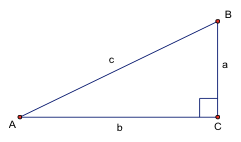
在 \(\Delta ABC\) 中,若 \(\angle ACB=90^\circ\) 且令 \(\theta=\angle BAC\),如下圖一所示,根據三角函數的定義, 則 \(\sin\theta=\frac{a}{c}\),\(\cos\theta=\frac{a}{c}\),\(\tan\theta=\frac{a}{b}\),\(\cot\theta=\frac{b}{a}\),\(\sec\theta=\frac{c}{b}\),\(\csc\theta=\frac{c}{a}\)。

直角三角形

圖一:現行高中數學教科書,銳角三角函數的定義是建立在直角三角形上。

三角函數值表

三角函數值表
國立蘭陽女中數學科陳敏晧老師

三角函數值表:現行的三角函數值表,是將三角函數的近似值算出並製成表格,表從 $$0^\circ$$ 到 $$90^\circ$$ 間(以 $$10’$$ 為單位,$$1^\circ=60’$$)的各種三角函數值,超過 $$90^\circ$$ 或小於 $$0^\circ$$ 的角,再利用廣義角的性質轉換。表中最左一行由上而下呈現的角度是遞增情形,對應最上一列由左而右有 $$\sin$$$$\cos$$、$$\tan$$、$$\cot$$、$$\sec$$、$$\csc$$ 各個函數符號;表中最右一行由下而上呈現的角度是遞增情形,對應最下一列由左而右印有 $$\cos$$、$$\sin$$、$$\cot$$、$$\tan$$、$$\csc$$ 和 $$\sec$$ 各個函數符號,因此,查表的簡易口訣為「左上右下」,下圖一為三角函數值表的部分表格。

圓錐曲線的定義作圖

圓錐曲線的定義作圖
臺北市立西松高中蘇惠玉老師

圓錐曲線的定義

拋物線、橢圓、雙曲線等圓錐截痕有各種不同的定義方式,目前高中教材中選擇的是與焦點與固定長有關的定義方式,分別定義如下:

拋物線:

給定一直線 $$L$$ 及線外一點 $$F$$,若平面上的動點 $$P$$ 滿足到 $$F$$ 點的距離等於到直線 $$L$$ 的距離,即 $$\overline{PF}=d(P,L)$$,則所有動點 $$P$$ 所形成的圖形為拋物線。

橢圓:

給定兩點 $$F_1$$ 與 $$F_2$$,以及一固定值 $$2a$$,其中 $$2a>\overline{F_1F_2}$$,若平面上的動點 $$P$$ 滿足到 $$F_1$$、$$F_2$$ 的距離和等於此固定值,即 $$\overline{PF_1}+\overline{PF_2}=2a$$,則所有動點 $$P$$ 所形成的圖形為橢圓。

雙曲線:

給定兩點 $$F_1$$ 與 $$F_2$$,以及一固定值 $$2a$$,其中 $$2a<\overline{F_1F_2}$$,若平面上的動點 $$P$$ 滿足到 $$F_1$$、$$F_2$$ 的距離差等於此固定值,即 $$|\overline{PF_1}-\overline{PF_2}|=2a$$,則所有動點 $$P$$ 所形成的圖形為雙曲線。

從這樣的定義方式並沒有辦法看出圖形的樣子,在還沒導出標準式之前,也無法藉由描點的方式畫圖。因此,要能夠「接受」這樣的定義方式確實可以畫出所定義的圖形,就必須經由作圖工具的輔助才行。

動態模擬軌跡方程式

動態模擬軌跡方程式
臺北市立西松高中蘇惠玉老師

在高中圓錐曲線的教材中,有一個教學目標為讓學生瞭解何謂軌跡方程式。藉由題目的設計,同時也讓學生理解圓錐曲線的來源,不是只有平面與圓錐的截痕,也不是只有按照定義方式才能得到。但是在學習過程中,學生們並不容易理解何謂動點(或動圓)?何謂軌跡?也很難從題目提供的條件「視覺化」的理解軌跡圖形為何?因此如果教師能夠藉由電腦軟體的模擬效果,將可讓學生輕易地經由「視覺」來理解幾何概念。以下為筆者整理在此單元教學時看過的幾個有關軌跡方程式的問題(問題來源皆為南一版學習講義第四冊),並試著以GeoGebra軟體來作動態模擬。

Pages